Showing posts with label how to. Show all posts

Friday, July 4, 2014

Numerical expressions - order of operations and solved examples


Numerical expressions are essential for knowledge of maths, and very important in its use in every day. To help you study maths, here you will learn what are numerical expressions and how to calculate numerical expressions. 


Numerical expressions

A numerical expression is a way of expressing reasoning in a problem and another way to represent a number. Any numerical expression represents a value. But you perceive better checking the following example: 


John went to the supermarket with 10 dollars and bought two cans of mushrooms and a bag of flour. Knowing each can of mushrooms cost $1.30 and the package flour $1.10, indicate: 

a) how much money was spent. 

To solve this problem, you must use the numerical expression: 2 x 1.30 + 1.10 
2 x 1.30 + 1.10 expresses the amount he spent, which is equal to $3.70. 


b) how much money is left. 

To solve this problem, you must use the numerical expression: 10 - (2 x 1.30 + 1.10) 
10 - (2 x 1.30 + 1.10) expresses the value that is left, which is equal to $6.30. 


How to calculate numerical expressions 

To learn how to calculate numerical expressions, is critical to realize that exists a series of operations, and so, there must be rules to implement them. This rules are called order of operations. So, to calculate numerical expressions, you have to know the order of operations of numerical expressions. Below, you can find an example with the rules explained to you understand more easily. 


  • Order of operations


In a numerical expression, the operations are not made simply by the order in which they appear. Each type of operation has a priority, which indicates which operations must be done in the first place. Then you can check the order of operations to calculate numerical expressions. 

1st Priority - Firstly, make all calculations within parentheses (these calculations must follow the rules described below). 
2nd Priority - For operations, we must first make the exponents or roots. 
3rd Priority – Calculate the multiplications and divisions in the order they appear. 
4th Priority - Finally, calculate the additions and subtractions in the order they appear. 


  • Solved examples of numerical expressions 


Let's start with a simple numerical expression: 

    23-4 x 5 =    --- 3rd P - Make first the multiplication 
= 23-20 =         --- 4th P – Make the subtraction 
= 3 


Now a solved example a little more complicated:

Numerical expressions - order of operations and solved examples


Friday, June 6, 2014

Calculate the area of ​​a triangle


Area is the surface that a given figure occupies. Before we show you how to calculate the area of ​​a triangle, observe the following situation: 

Calculate the area of ​​a triangle


Through this practice activity, one comes to the conclusion that if we divide a parallelogram by its diagonal, we get two equal triangles. Thus, we can say that the area of each triangle will be equal to half the area of the parallelogram. If the area of the parallelogram is equal to the product of its base by its height, then the area of a triangle equals half the product of its base by its height. 


To calculate the area of ​​a triangle simply apply the following formula:

Calculate the area of ​​a triangle

Tuesday, June 3, 2014

Area of the square and rectangle


Area  is the surface that a given figure occupies. To calculate the area of the square and the rectangle, you must measure the length and width of the figure. Since the square has all equal sides, in this case it is considered the measure of the side. To calculate the area of the ​​square and rectangle just apply the following formulas: 


  • Area of the square 


A = side x side = s x s


  • Area of ​​the rectangle 


A = length x width = l x w

Tuesday, May 27, 2014

How to find gcd (greatest common divisor)


The divisor of a number is a natural number that divides another, and which results in an integer. For example, the dividers of 12 are 1, 2 , 3, 4, 6 and 12. Set of divisors of a number is always a finite set of numbers.

12: 1 = 12
12: 2 = 6
12: 4 = 3
12: 4 = 3
12 6 = 2
12: 12 = 1

D12 = { 1,2,3,4,6,12 }

The gcd (greatest common divisor), as the name implies, is the greatest common divisor of two or more numbers integers. For example, if D12 = { 1,2,3,4,6,12 } and D18 = { 1,2,3,6,9,18 }, the greatest common divisor between 12 and 18 is 6. Yet, if instead of making the gcd of 12 and 18, we do the gcd of two much larger numbers, it will take too long. Thus, instead of making the dividers of each number, there is a faster method.


Now we'll explain how to do the gcd of two or more numbers integers.


Step 1

By making the decomposition in prime factors of each number. If you don't know how to decompose a number into prime factors, click here.


Step 2

After you've decompose down each number into its prime factors, you will choose the smallest common factors. The non common factores doesnt interest.


Step 3

Calculates the product of the selected factors . The result is the greatest common divisor of the two given numbers integers.

Tuesday, May 20, 2014

Helping your child learn math


If you are a parent or an older brother, and want to help your child succeed in maths, then there is a set of important tips you should follow. So, start helping your child learn math.

tips to help parentes help their child study maths


Tips - helping your child learn math


  • Become interested in your child's learning


Follow up and have some knowledge about the content that your child is learning is important, both to assist in their study, as well to suggest everyday problems for practice.


  • Do not simply memorize!


Mathematics is, above all, reasoning. So do not encourage your child to memorize the matter but to perceive it and practice it. However, as with everything, there are situations where it is important to memorize. For example, the multiplication tables is an essential tool to achieve progress.


  • Mathematics is "cool"


A major problem in kids today is the idea that mathematics is boring and uninteresting. Reinforce the idea that mathematics is very interesting and worth the effort.


  • Strengthen the bases


In maths, nothing is lost. This is a cumulative discipline, and as such, all that is behind is important for future learning. So, you must ask your child to regularly evaluate other previous contents, especially if they are related to matters that are learning at the time .


  • Autonomy


Help your child to study maths does not mean always sit with him and helps him with his exercises. Most of the time, you just have to give him the tools he needed to get to be autonomous and able to study maths alone. To do so, he must apply the method of study that we explain here.


  • Give positive reinforcement


Not all children develop at the same time, or have the same capacity to be able to have the same success in maths. However, the most important is that all evolve. This requires a positive reinforcement whenever he reaches a certain goal.


  • Learning from errors


The error is one of the most important tools to evolve in Maths. If you find an error in your child's answers, do not correct: you muts draw his attention to the existence of a error for him to find the correct answer himrself.


  • Encourage your child


There are many games and books related to maths, where your child can have a slightly more relaxed and fun relationship with this discipline that will help him increase his interest, and of course, his ability to learn new things.

Saturday, May 17, 2014

Easy way to divide fractions


Here you can learn a esay way to divide fractions. Unlike addition and subtraction of fractions, division is a simple, easy to learn method. But to learn this easy way to divide fractions, you have to know before how to multiply fractions, and what is the inverse of a number. If you need to study maths, here you can find all you need.


Inverse of a number

The inverse of a number is the number that, multiplied by the first number, gives the result 1.

example:
3 is the inverse of 1/3 and vice versa.
2/5 is the inverse of 5/2 and vice versa,


Now we will explain to you a easy way to divide fractions


  • Easy way to divide two fractions:


To divide two fractions, replace the signal division by the multiplication sign, and the second number by its inverse. Then simply multiply both fractions.


  • Easy way to divide fractions by a whole number:


If you want to know how to divide fractions by a whole number, you only have to do what was done above, and in the end multiply the numerators and denominators.


Tuesday, May 13, 2014

Easy way to multiply fractions

Here you can learn a easy way to multiply fractions. Unlike addition and subtraction of fractions, multiplication of fractions is a very simple, easy to learn, method. So, to help you study maths, here we will explain a easy way to multiply fractions.


  • How to multiply two fractions:


To multiply two fractions, simply multiply the numerators and denominators.

examples:


  • How to multiply a whole number by a fraction.


Here you have a easy way to multiply fractions by a whole number. You only have to multiply the numerator by the whole number, keeping the denominator.

examples:


Tuesday, May 6, 2014

How to make a tangram

The tangram is a mathematical game much used in the classroom, but also as simple fun. In this game you can develop your skills of logic, geometry and creativity. Tangram is simply a square divided into 7 geometric pieces with which you can get thousands of different images. Its origin is uncertain, but is thought to have been invented in China. Here you can learn how to make a tangram.


The tangrams can be acquired, existing in various materials, such as wood or plastic. But if you do not want to buy, you can make a tangram in your house. Here you'll learn how to make a tangram. 


How to make a tangram 

To make one tangram you gonna need paper (preferably thick, to be more resistant), scissors, pencil, ruler and eraser. Below you can learn how to make a tangram, step by step.


Tuesday, April 29, 2014

How to calculate the volume of solids


Volume is the space occupied by a given object. The volume is measured in cubic units. For example, we can say that a cube is 64 cubic cm. The basic unit of volume is the cubic meter. There is equivalence between the volume of an object and its capacity. The simplest method used to equate volume capacity is 1 cubic decimeter = 1 liter. 


To calculate the volume of an object, you must use three dimensions: length, width and height. To help you study maths, here you can know the formulas for calculating the volume of various geometric solids. Just click in the following links:


How to calculate the volume of solids:

Monday, April 14, 2014

How to calculate the volume of a pyramid

The pyramid is one of the most popular geometric solids, mainly due to the egyptian pyramids, used as funerary structures of the ancient Pharaohs of Egypt. Here you will learn how to calculate the volume of a pyramid.

How to calculate the volume of a pyramid
Photo by Ricardo Liberato


The volume of a pyramid equals the space that that pyramid occupies. To help you study maths, here you'll learn how to calculate the volume of a pyramid .

How to calculate the volume of a pyramid


To calculate the volume of a pyramid, you have to know the area of the base and the height of the pyramid. The volume of a pyramid is the product between a third of the base area and the height of the pyramid.


pyramid volume formula


You must remember that there are pyramids with various base. Thus, the formula for calculating the base area changes in accordance with the base of the pyramid. For example, if you have a quadrangular pyramid, the base area is calculated by multiplying the length by the width, but if you have a triangular pyramid, the base area results from half the product of the length and height.


image of solid geometric pyramid : Andrew Kepert

Friday, April 4, 2014

How to find the volume of a cone

The volume of a cone is equal to the space that cone occupies. To help you study maths, here you'll learn how to find the volume of a cone.

How to find the volume of a cone


The volume of a cone its equal to one third of the volume of the cylinder. So, you just multiply the volume of a cylinder by a third. To find the volume of a cone, you have to know the radius of the base (circle) and the height of the cone. The volume of a cone is the one-third of the product of the area of the base with the height of the cone. 

How to find the volume of a cone


Do not forget that: 

- The most used rounded value of Pi is 3.14 
- Diameter = 2 x radius

Tuesday, March 25, 2014

How to find the volume of a parallelepiped

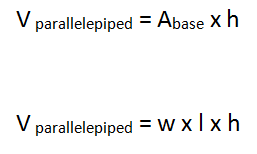
The volume of a parallelepiped is the space that the parallelepiped occupies. To help you study maths, we'll explain how to find the volume of a parallelepiped. 


To calculate the volume of the parallelepiped, you'll need to know the length and width of the base and the height of the solid. Thus, the volume of a parallelepiped is the product of the base area with the height of the solid. Then:


w – widht
l – lenght
h - height


We hope that this article was helpfull to you learn how to find the volume of a parallelepiped, and to you study maths.

Friday, March 21, 2014

How to find volume of a cube

The volume of a cube is the space that the cube occupies. To help you study maths, we'll explain how to find volume of a cube. 

animated cube


The cube is a geometric solid in which all edges have the same measure. Width, lenght and height have all the same measure. Thus, as the volume of an object is calculated by the product of the length and the width and height, then:

cube volume formula

a - edge


Hope that this was helpfull to you learn how to find volume of a cube and to you study maths.